
Conversation intelligence for sales teams
Know why every deal moves — and show the call that proves it.
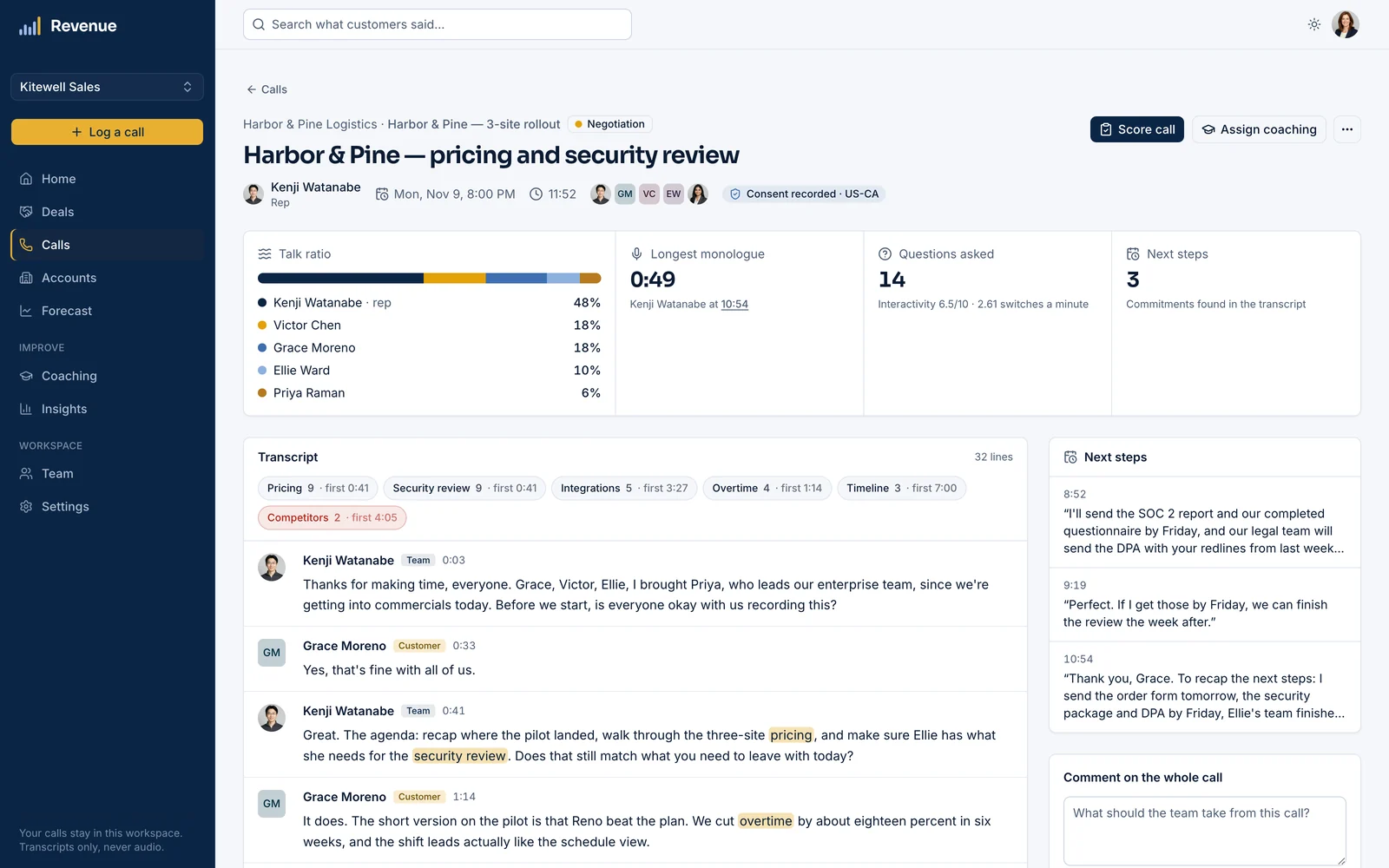
Log consented call transcripts against your deals. Revenue measures talk ratio, questions and next steps, flags deal risks, and links every number to the moment in the call it came from.
Free and open source. Works from transcripts — no bots join your meetings.
Consent first
No transcript is stored without a jurisdiction, a consent basis and an all-party confirmation.
Deterministic
Rules, not guesses: the same transcript always produces the same analysis.
Evidence-linked
Every metric, risk and next step jumps to the moment in the call that caused it.
What you get
Call analysis your reps can check for themselves
Every insight is a rule you can read, applied to a transcript you can open.
Transcripts in, analysis out
Paste or upload a WebVTT, SRT or “Speaker: text” transcript. Revenue computes talk ratio, longest monologue, questions, interactivity, tracker hits and next steps — the same input always gives the same result.
Consent before anything is stored
Every call needs a recording-consent record: jurisdiction, consent basis and an all-party confirmation. Without it, the server refuses the transcript.
A deal board with risk signals
Stages, amounts, close dates and contacts with deal roles. Each risk signal says which rule fired and links to the call — and timestamp — that caused it.
A forecast built from real deals
Commit, best case, pipeline, weighted pipeline and closed won, by month and by rep. The owner's call stays visible; manager overrides need a reason and are audited.
Coaching on the exact moment
Comments at a timestamp, scorecards against a weighted rubric, clips collected into playlists, and coaching assignments reps acknowledge.
Redaction and retention
Redact an exact span and the original text is never kept. Set a retention period, preview which calls it would delete, then apply it.
How the numbers work
Every metric and risk has a written definition
The same definitions sit next to the numbers in the product, so a rep can see exactly why a deal is flagged.
Call metrics
- Talk ratio
- Each speaker's share of the conversation, per call and averaged per rep.
- Longest monologue
- The longest uninterrupted stretch by a single speaker.
- Questions
- Questions asked in the call, counted per speaker.
- Interactivity
- Speaker switches per minute, scaled from 0 to 10.
- Next steps
- Commitments found by named phrase rules, each linked to its moment.
- Tracker hits
- Your keywords and competitors, with the timestamp of every mention.
Deal risk rules
- No calls
- Fires when: An open deal has no logged call.
- Gone quiet
- Fires when: No call within the number of days you set.
- No next step
- Fires when: The latest call has no detected next step.
- Competitor mentioned
- Fires when: A competitor tracker fired in the latest call.
- Close date passed
- Fires when: The deal is open past its close date.
- Single-threaded
- Fires when: Calls have heard exactly one linked customer contact.
- Stalled in stage
- Fires when: Longer in one stage than your threshold (30 days by default).
How it works
From a call transcript to a deal you understand
No recording, no meeting bot: just the transcript your meeting tool already gives you.
Build your pipeline
Add accounts, deals with stage, amount, close date and owner, and the contacts on each deal with their role.
Log a consented call
Paste or upload the transcript against a deal and record consent. The form previews the parse and the analysis before you save.
Review the analysis
Read the transcript with tracker highlights, jump to any moment, link speakers to contacts, comment and score the call.
Act on the deal
Risk signals on the board, a timeline of stages and calls, and a forecast category the owner calls and managers can override with a reason.
Bring your transcripts
Works with the transcripts you already have
Revenue doesn't record calls or send anything into your meetings. Export a transcript from the meeting tool you use, paste or upload it against a deal, and record consent.
- A consent record is required before a transcript is saved
- See the parsed transcript and the analysis before you commit
- Re-analyse any call later with your current trackers
Open source, open records
Your calls and pipeline stay yours
Revenue is free and open source under the AGPL-3.0. Read every rule it applies, and export the whole workspace whenever you want.
A complete export
Accounts, deals, calls with transcripts and consent, comments, scorecards, trackers, contacts, members and audit, as versioned JSON.
Signed webhooks
call.analyzed and deal.stage_changed, signed with HMAC-SHA256. Payloads carry analysis numbers, never transcript text.
An audit log without transcripts
Every change is recorded with who and when. Transcript text and redacted words never enter the audit log.
Roles for real sales teams
Admins, managers, reps and viewers, checked on the server for every read and write.
Questions
What sales leaders ask first
Put every deal on the record
Create a workspace, add a deal and log your first consented call transcript.
Start your workspace